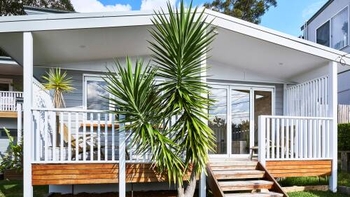


Fresh data has revealed large, shared homes are making a comeback.
It is a turnaround after a significant number of renters sought isolation during COVID-19 with big properties recording stronger rental growth than smaller dwellings.
Renters are now looking to share with friends and family to reduce rental costs, which are defrayed by more people sharing the financial burden of renting in a market where the national median rent reached $634 a week in June, up $48 year on year.

Eliza Owen, Head of Residential Research for CoreLogic, said several factors are at play.
"There are stronger rental growth trends in larger dwellings, potentially reflecting the formation of share houses or multiple family households with a 9 per cent rise in rents for houses with five bedrooms or more," she said.
This contrasts with rents for one-bedroom units and studios slowing from 17 per cent in the year to April 2023 to 7 per cent in the past 12 months.
"A slight slowdown in net overseas migration might be a driving factor in slowing demand for this sector," Owen said.
"Interestingly, larger rental properties are showing more resilient rent growth despite being more expensive.
"Large rental properties may actually be more feasible for renters in share situations, including reforming group households and multi-generational households."

She said the trend is largely led by NSW and Queensland.
Melbourne is also showing distinctly higher growth in house rents with five or more bedrooms.
However, "in most capital cities, two-bedroom units have sustained the highest increases in rent over the years," said Owens.
And she added that while two-bedroom units yield higher, the capital growth of this investor staple lags three to four-bedroom units and houses of all sizes.
Owen expects the large share house trend to persist and potentially extend to cheaper rental markets such as Perth and Adelaide.
"Tenants will find it cheaper to rent a room in a big house than rent a place by themselves and the further we get from lockdowns the more feasible it is to rent a share home and the higher the cost of living gets the more we might see tenants get pushed into those share homes," she said.
"From the investor perspective, depending on your strategy, just be conscious that it's actually smaller properties that deliver higher gross yields.
"But, as we've seen from this data, larger properties are likely to attract a higher capital growth rate."