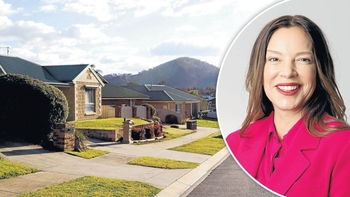


Sophie Southwell recently purchased her first home, but keeping property values high won't be top of mind when it comes to casting her ballot in the federal election next month.
That's because she'd like to see her peers get a foot on the property ladder too, and, fresh out of the buying process, she understood how difficult it could be.
The 29-year-old purchased an apartment for $390,000 in Kurri Kurri, around 40 minutes from Newcastle in NSW, using a low deposit loan.
"Everything was priced so high and I found it really difficult looking, because I was getting outbid on each house. I kind of had to look in an area where I didn't want to purchase," she said.
As the federal election approaches, she said she would be keeping an eye on what politicians have to offer first home buyers, along with how they plan on tackling cost of living pressures.
"I think for first home buyers it is quite difficult and the government could be doing more, especially if you're on a single income," she said.
"I feel a lot better that I've got my foot in the door at this time, because I don't think it [housing affordability] will ever get significantly better," she said.
"I want other first home buyers to have the opportunity to buy as well," she added.
She thought the government could do more to help, such as offering more grants or building housing stock specifically allocated to the first home buyer market.
With a variable rate mortgage, what happens to the official cash rate in the coming months, and whether politicians from either side of the political divide can do to ease the cost of living pressures faced by Australians, will have more immediate importance than what happens to house values.
"I think it [interest rates rising] would affect my vote if that was the case," she said.
Vested interest in the status quo
A recent survey conducted on behalf of the Property Council of Australia found that many younger Australians share Ms Southwell's sentiments, with housing affordability shaping up as a significant election issue for Millennials and Gen Z.
But the significance of housing affordability as a political issue tended to decrease with age, the survey suggested, as well as whether respondents already owned their own property.
For example, less than half of those respondents aged 55 and above agreed that the government should be doing more to help first home buyers, compared to two thirds of those aged between 18 and 34.
Respondents who owned a home already were also more likely to agree that the government was doing enough to help young people purchase their own home than those who were renting and looking to buy a home at some point in the future.
Economist Saul Eslake said that the vested interests of existing homeowners explained why political parties from both sides of the divide were unwilling to tackle structural issues in the housing market, like removing tax concessions for property investors or increasing the supply of social housing, that might lead to a reduction in demand for property.
He suggested that the reason governments keep opting for schemes like the First Home Guarantee was that it gave the appearance of assisting first home buyers while simultaneously inflating demand for existing housing stock.
"The reason that governments, and oppositions, keep coming up with schemes like this - despite the overwhelming evidence that they don't work and indeed have counter-productive results - is that, for all the 'crocodile tears' that they routinely shed about the difficulties faced by aspiring young first-time buyers, they know that in any given year there are on average only about 100,000 of them," Mr Eslake said.
"And while those 100,000 voters, and perhaps another 200-500,000 voters who aren't able to achieve their dreams, would like governments to stop doing things that simply add to house price inflation, politicians know that there are 11 million voters who own at least one property, mostly their own home, and that within that number there are more than 2 million who own two or more properties - and the last thing those voters want politicians to do, or promise, is anything that might reduce the rate of property price inflation. So, even the dumbest of our politicians can do that arithmetic fairly easily," he added.
Never been easier for first homebuyers
But buyer's agent Jack Henderson, who helped Ms Southwell find her home, questioned what more the government, or the opposition, could do to help first home buyers.
"I think the reality is that regardless of who gets in [at the election] that neither of the parties are going to be able to save or help first home buyers in any significant way ... Getting into the property market at the moment is the easiest it's ever been, with 5 per cent deposits and no lenders mortgage insurance," Mr Henderson, said.
"If people really wanted to do it they'd do it," he added.
Mr Henderson, who is 25-years-old, said that some younger people might be looking to place blame on politicians for not being able to get into the property market, without looking at what sacrifices they could make to their lifestyle in order to secure a property.
"A lot of people, especially first homebuyers, want to put the blame on someone else and not take responsibility for their own actions," he said.
He said that many of his clients were "aspirational" buyers who didn't come from wealthy backgrounds.
"A lot of our clients are first home buyers who are taking action," he said.
Absent any intervention from the winner of next month's federal election, Ms Southwell said budding homebuyers may have to temper their expectations, like she did.
"They might just have to start small or look at other areas," she said.