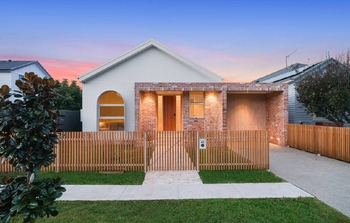
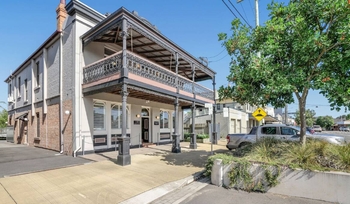
The ongoing construction of a unique housing project at Corrimal is catching the attention of passers-by.
"People walk past and ask what it is, so I put up some signs on the street, and I just invite them in to have a look," builder James Forrest from Forrest Small Homes said.
The project to construct four row homes on the site is being undertaken in conjunction with SAHA, a design studio based in Sydney, and a developer.
Read more: 'Grateful to get in': Retro entry-level Thirroul property quickly finds a buyer

The four row homes are one of 17 low- and mid-rise designs by architects in the NSW government's Housing Pattern Book. More than 21,000 patterns were sold, most at the introductory price of $1 each.
Two projects, including the SAHA row homes are under construction so far.
The Corrimal project was was approved earlier this year. It's one of 17 applications that received fast-track approval.
Read more: Wow factor: Does this Coalcliff home have the greatest view in the entire Illawarra?
How it works
Mr Forrest is based in the Sutherland Shire, but regularly undertakes projects in the Illawarra.
He's aiming to be the state's first builder to complete homes using an architect's plan bought for $1 from the government's new pattern book.
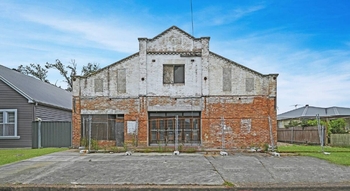
Mr Forrest is building the four row homes on a Corrimal block where a 1950s two-bedroom home formerly stood.
He's doing so utilising a SAHA design featuring three three-bedroom homes of about 110 square metres each, and a two-bedder of about 85 square metres.
Mr Forrest said it was an 11-month process, and he needs to finish by November to ensure its the first in the state to be completed.

He said the developer will eventually tenant out the homes to a real estate agent to be rented out, and they were set up for young families with features including a bath.
Mr Forrest said this type of housing could help address some of the region's affordability issues.
"We've been waiting for the government to release this legislation for about six or seven years," he said.
"When it did come out, I was one of the first ones on it. I looked through all of the models that they came out with under the scheme.
"I saw this one, the row homes, and straight away identified that it's the best opportunity for providing affordable housing.
"It's the best version of it for a number of reasons. But I believed in it so much that I reached out to a developer, found a site, put my money where my mouth was and built it.

"I think it's an alternative to the duplex-ification of the Illawarra. I think this is much more amenable to the street, and provides not two homes, but four. And they are really good homes."
The row homes can be built on blocks as small as 500 square metres and with 13 metres' frontage.
"But it's very particular the types of blocks you can use, and there are different zoning requirements," Mr Forrest said.
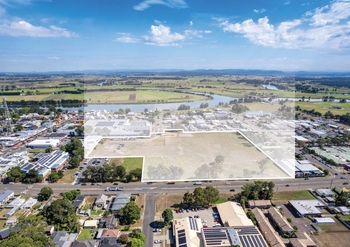
"The one at Corrimal is on a normal residential block of land. It was a slightly larger than average block, 833 square metres.
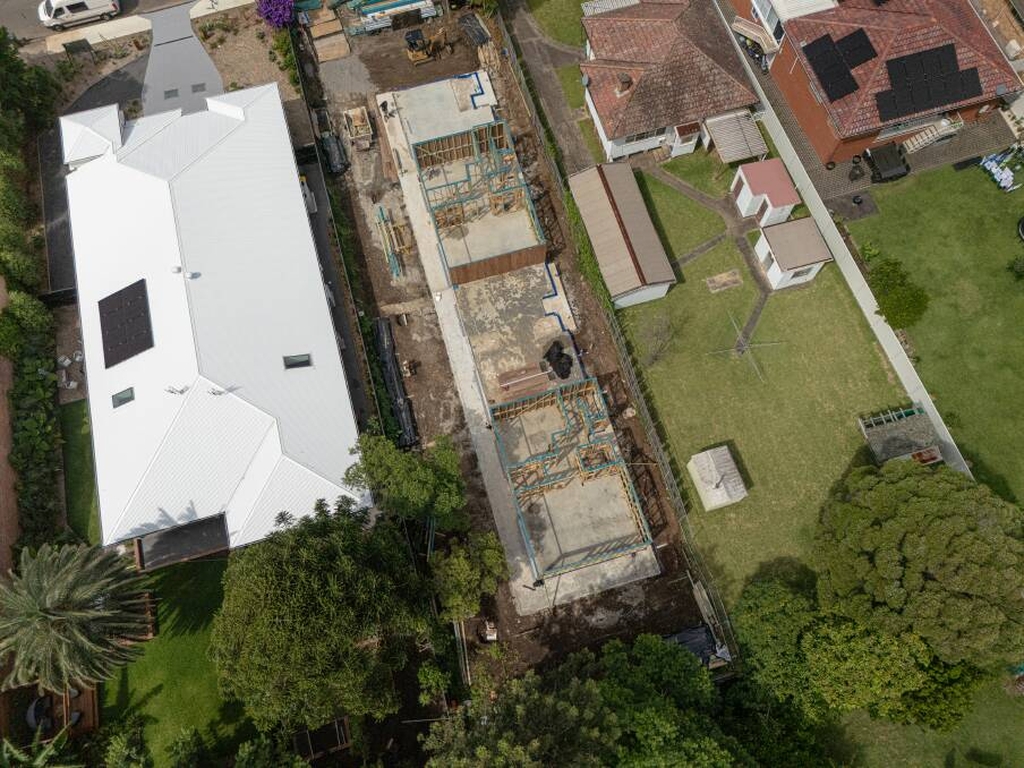
"But you're getting four homes on there, genuine homes. They go in a row from the street backwards.
"The home closest to the street is two bedrooms and two bathrooms, with a study, while the next three homes are all three bedrooms, two-and-a-half bathrooms and a study."
The design can have a mix-and-match approach, with three, two and one-bedroom modules possible, and the ability to construct three or four homes.
"The site would determine what you could put on it," Mr Forrest said. "On a 500 square metre block, you might get four one-bedroom homes.
"Otherwise you'd just be putting one house on it... It's a great solution."

How it could help
Mr Forrest said these homes could be both a downsizing option, and subsequently a way to get into the market for multi-generational families.
Mr Forrest said hehopes long-time home owners who are ageing out of their "blocks with one house on them, and their kids can't afford to buy", could use this model. Ideally, the owners build these homes and keep one for themselves.
"That way they get to stay where they want to live," he said.

"You could stay around your support network. They're fully separate titles, so you could sell them separately if you like.
"It's a great solution for people who are sitting on a block that they don't know what to do with when they're ageing and want to help their kids.
"They're big enough for small families, and really economical to build and sensibly designed."
SAHA's co-founder, architect Sascha Solar-March said the row home offers areas like the Illawarra a much-needed middle ground, bridging the gap between apartments and standalone houses.
"It can provide an option for growing families who need more space and a garden, while also offering downsizers a simpler, lower-maintenance home - something the region has been missing," he said.